
GolfZon · Lakeville & Stillwater
The bays
You hit a real ball with a real club into a screen. The floor under you tilts to match the lie, a sensor in that floor reads the ball, and cameras overhead read the club. Nothing is strapped to you and nothing needs setting up.
- Bays
- 10
- across two venues
- Balls
- Included
- every bay has its own — never bring your own
- System
- TwoVision NX
- GolfZon, tour spec — the same kit as their own tour
- Course availability
- 300+
- courses worldwide, plus arcade games
What the machine reads
Every bay runs a GolfZon TwoVision NX — the current model. Two different parts of it are watching, and they are watching two different things.
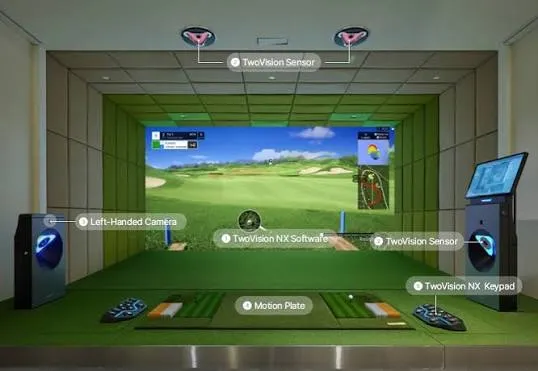
Cameras overhead read the club
Club path · Angle of attack · Club face impact area
A sensor in the floor reads the ball
Ball speed · Direction and trajectory · Spin rate · Launch angle · Spin axis
That is why the numbers mean something. The ball data is measured off the ball itself rather than inferred from the swing, so what comes back is what actually happened.
System
GolfZon TwoVision NX
Specification
Tour spec
The same equipment GolfZon requires for its own tour — the current TwoVision NX with the motion plate under you. Not an older unit with a new badge on it.
What that looks like
Four things the machine does that are hard to picture from a sentence. Each one is a few silent seconds — they start when you scroll to them, and you can stop any of them.
These are GolfZon's own films of GolfZon hardware — the system that is in our bays, but not our rooms and not our footage. The lighting is theirs. The carpet in Lakeville is considerably more ordinary.
The course is built, not photographed
A links hole with real contour on it — rendered, so the ground is a surface with a slope rather than a picture of one. Land short on a downslope and the ball runs out; land in the rough and it does not. That is the difference between a screen you hit at and a course you play.
Silent loop: an aerial map of a golf course, then play down a coastal links fairway, the ball landing and running out with the shot data along the foot of the screen.
Numbers come back on every shot
Ball speed, launch angle, spin — on the screen, per shot, whether you asked for them or not. On the green it draws the slope over the surface so you can see the break. This is the part people underestimate: you find out what your 7-iron actually carries, which is rarely what you have been telling people it carries.
Silent loop: a shot traced away down a driving range, then a putt on a green with the slope drawn across it as a coloured break map.
The floor tilts to match the lie
Not a figure of speech — the plate under you physically lifts and drops. GolfZon builds it in five segments, one under the ball and four under your stance, with fairway, rough and bunker mats. That is the part people do not expect, and it is why the ball behaves like it does outdoors rather than like a video game.
Silent loop: the swing plate under a player rising at one edge and settling, with its travel measured against a drawn scale.
You stand on the slope, not next to it
Because the surface moves, your weight has somewhere to go. You set up to an uphill lie the way you would outdoors — leaning into it, feet doing the work — instead of standing square on a flat mat and imagining the hill. Your body works it out faster than any tip does.
Silent loop: a player’s feet on the lit swing plate as its surface rises into a slope beneath them.
The floor moving under you is the one nobody believes until they stand on it.
What is where
Ten bays across two locations. Lakeville has been open since 2022. Stillwater opened in 2026.
The Links of Lakeville
Bays
6
TV's
9
Golfer capacity
36
Club rental
$15 a set
Basic sets, not fitted. Bring your own clubs if you have them.
What separates it from hitting into a net
- Auto tee-up and ball return
- The machine tees the next ball for you. You do not bend down between shots, and you do not run out of balls — they are included, and you never bring your own.
- A touchscreen next to you
- You pick the course and the settings from the screen in the bay, and it scores the round for you. Staff set it up on your first visit; you do not need to know anything going in.
- Nothing attached to you
- No tags on the club, nothing clipped to your belt, no calibration ritual. You walk in, and the bay is already watching the ball.
Practice, play, or just mess about
- Play a course
- Eighteen holes on a real course, rendered hole by hole. Budget about an hour per person — four of you in one bay is roughly a four-hour round, which is why most groups play nine or split across two bays.
- Practise
- A driving range and a putting green with no queue, no weather and no lost balls. Every shot comes back with numbers, which is the point — you find out what your 7-iron actually carries instead of what you tell people it carries.
- Play a game
- Closest-to-the-pin, longest drive, and the arcade-style formats. This is what a group who do not really golf ends up playing, and it is fine.
What you can change in the bay
Staff set the bay up on your first visit, so none of this is homework. It is here because people ask what they are allowed to change, and the answer is nearly all of it — most of it per player, from the screen beside you, in about a minute.
- How hard you want it to be
- Four levels, and each player in the bay picks their own — so a first-timer and a scratch golfer can share a round without either of them having a bad night. Beginner holds the floor flat and helps the ball along: less slice and hook, easier out of the rough and sand, and a bit more distance. Amateur and Pro bring the floor back and take the help away by degrees. Tour plays about like golf outdoors, and it is what most people here settle on.
- How hard the course plays
- A separate setting from your own, and it applies to the whole round. Casual is the gentlest. Semi-Tour is the one the venue suggests — closer to outdoors without being unkind. Tour gives you very little help and is worth saving until you know the system.
- How short a putt is given
- The concede distance. Six feet is the shortest it goes, and it is the setting that keeps a four-ball moving.
- Which tees you play off
- Black, blue and the rest — the same choice you would make walking onto a real first tee, and worth taking one box forward if the group is mixed.
- Tee height
- Set per player, and it can be changed part way through a round if the driver is not sitting right.
- The swing plate
- The floor under you tilts to match the lie you are standing on. Leave it on Difficult — that is the setting that plays most like being outdoors, and it is the one the venue suggests keeping.
- Wind, greens and pins
- Wind, green speed and firmness, and the pin position are all chosen before you tee off. Turning the wind off entirely is a perfectly respectable thing to do.
- How you play it
- Stroke play, match play, scramble and foursomes are all there, along with the arcade games — ask staff to set those up. One thing worth knowing before you start a scramble: teams are picked at the beginning and cannot change mid-round.
If it does not register your shot
Three things account for nearly all of it, and none of them means you have broken anything — the machine has simply not seen the shot. Staff will sort any of it out if you would rather not fiddle.
- The ball is on the tee, you swing, and nothing happens
- Check the club. When the bottom right of the hitting screen says TEE, the club has to say DRIVER — if it does not, choose DRIVER and hit again.
- You putt and the ball does not move
- Check whether the ball is on the APRON, shown at the bottom right of the hitting screen. If it is, the club selection on the kiosk needs to say PUTTER.
- You hit off the mat, the rough or the sand and nothing happens
- Look for a blue circle around the ball on the hitting screen, and a blue strip of light on the keypad. If neither is there, the cameras cannot see the ball — move it away from the edge of the hitting area and try again.
Never used one?
Staff start the bay for you and show you the screen. Turn the difficulty down, turn the wind off, and take as many shots as you like — there is no group behind you and the bay is yours for the hour. If you top one, the machine tees another ball up.
You do not need clubs, you do not need shoes, and you do not need to know the rules.
A bay is $35 an hour through October 3rd, 2026 — per bay, not per person, up to six of you.